
Romulus Previous Residents by Era
Past households leave different kinds of evidence. The current parcel supplies a legal description and physical key. A recorded deed supplies the transfer parties and date. A permit can mark a project at the structure, while an old directory, newspaper, or census entry can associate a household with an address at a particular time. None of those sources answers every question. In Romulus, the useful method is to keep an era-by-era chain and label whether an item shows title, a property event, or a historical address association.
| Historical source | Era available | Romulus access point | Evidence for past residents |
|---|---|---|---|
| Parcel and assessment record | Current city assessment, older span not stated online | BS&A or the Romulus Assessor | Parcel, legal description, improvements, sales and tax-map context |
| Wayne deed index | Index reaches 1703; online date needs confirmation | Register search, office, or mail route | Recorded transfers, parties, instrument and legal-description trail |
| Permit and occupancy records | Dates depend on the requested record | Building & Safety, published service, counter, or FOIA | Project and property milestones, not proof of occupancy |
| Directories and newspapers | Exact Romulus directory run unconfirmed; papers 1968–2008 | Library, Library of Michigan, or digitized newspaper collection | Dated address associations and public household context |
| Museum and cemetery material | Collection-specific | Historical Museum/Archives and cemetery research routes | Maps, assessment rolls, genealogies, obituaries, and local history |
Begin with the present parcel when the house still exists. Then move backward through recorded transfers before looking for household clues. That order prevents a newspaper mention or a directory line from being mistaken for ownership. It also leaves room for a split, combination, probate transfer, correction, or other break in the recorded chain.
Romulus Address History Starts With a Parcel
The Wayne Parcel Viewer service provides the map-side starting point. Use it to identify the subject parcel, its shape, adjacent context, and parcel ID. Then compare that ID and the situs address with BS&A Romulus or the Assessor’s public card. A situs address is the physical parcel address. It is not the same thing as an owner’s mailing address, and neither by itself establishes who lived in the building.
One-address trail: address → parcel ID and legal description → assessment context → recorded deed → property-event records → dated household sources. Keep the legal description exactly as printed. It can bridge a parcel-number change or an address change better than a guessed old street number.
BS&A is a starting point only. Its stable landing page does not establish that every appraisal-card field is available online, so use the assessor channel when a card or record detail is needed.
Romulus Past Residents in Wayne Deeds
The Wayne County Register of Deeds search-services page separates a free, limited name listing from paid expanded access. The free index is a first pass for a grantor or grantee name. Address, legal-description, parcel or tax-ID, and Liber/Page routes are listed through On Demand. The county lists individual On Demand access at $6 for 15 minutes or $24 for 60 minutes, plus image and print charges. An office search is listed at $5, copies at $2 per page, certification at $10 per document, and a mail address search at $15 per address.
| Grantor or grantee name | Free index name search, with listing-only access. |
|---|---|
| Street address | Expanded On Demand search route. |
| Legal description | Expanded On Demand search route. |
| Parcel or tax ID | Expanded On Demand search route. |
| Liber or page | Expanded On Demand search route. |
| Image or print | Paid or account-based action, with applicable charges. |
The date range needs care. The Register says the index reaches 1703, but its search-services page describes online land records from January 1, 1960 while another county page says online documents after 1986. Treat neither statement as a complete answer for an older Romulus address. Record the conflict and confirm the needed period with the office, kiosk, or mail route.
The Wayne Register public-search landing page is the county’s entry point for the land-record search.
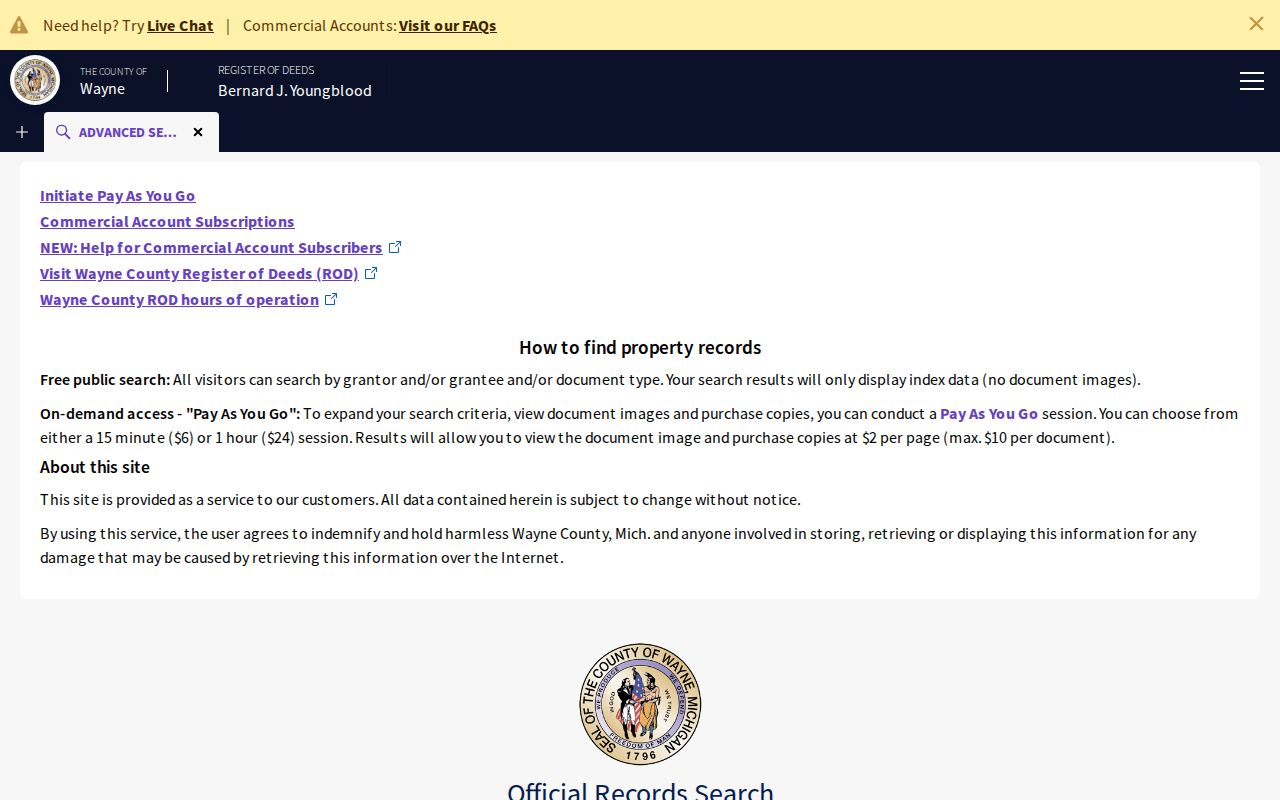
A name in an index is a lead, not title proof. The recorded instrument and the parcel’s legal description are the documents that connect a transfer to the right property.
Trace Romulus Past Residents Through Deeds
Work backward from the most recent recorded transfer. Take the buyer from that instrument, then find the earlier deed in which that same party acquired the parcel. At each link, compare the legal description, parcel reference, instrument date, and transfer type. A change in a street address does not end the inquiry if the legal description remains consistent. A break in the sequence may reflect a probate transfer, foreclosure, correction, split, combination, release, or an earlier record that needs office or archive help.
- Pull the parcel ID, legal description, and current assessment context from BS&A, the Assessor, or county GIS.
- Find the present owner’s purchase instrument in the Register index and note its document number, recording date, and type.
- Use the seller on that instrument as the next historical buyer, then look for that earlier acquisition.
- Repeat the comparison backward, preserving each legal-description change and uncertainty in the chain.
- When the online trail reaches its uncertain period, use the Register’s office, counter assistance, or mail search instead of assuming the chain ends.
- Grantor and grantee
- The grantor transfers an interest in the instrument. The grantee receives that recorded interest.
- Chain of title
- A dated sequence of recorded transfers and related instruments affecting the same parcel. It is research evidence, not a legal title opinion.
- Legal description
- The lot, subdivision, metes-and-bounds, or other formal land description that identifies the parcel beyond its street address.
The Register’s fee and copy guidance illustrates the difference between a free index listing and an image, office copy, mail search, or certified copy.
Choose the access channel that matches the needed evidence. A historical timeline can often start with an ordinary image or office inspection; certification is a separate county procedure.
Romulus Address History and Property Milestones
Assessment and building records can date the property without claiming who occupied it. The Romulus Assessor identifies public appraisal-card information such as legal description, lot dimensions, improvements, sales date and price, square footage, tax maps, year built, and assessed or taxable value. The Assessor does not offer a stable public search form. Records may be inspected or requested in person, by phone, email, or fax, and the City lists a one-to-two-business-day response for the office channel.
Building & Safety records and forms use a project address, property ID, subdivision, zoning, project type, permit, inspection, and occupancy fields. These can establish a project or final-inspection milestone. They do not establish that a named owner, applicant, contractor, or contact lived at the address. When a defined older city record is not online, a request under Michigan FOIA can be made by form, letter, email, fax, mail, or documented verbal request. Specify the existing record type, date range, address or parcel, and preferred format.
The Romulus Archive Center provides keyword, category, time-period, and date controls for public archive material.
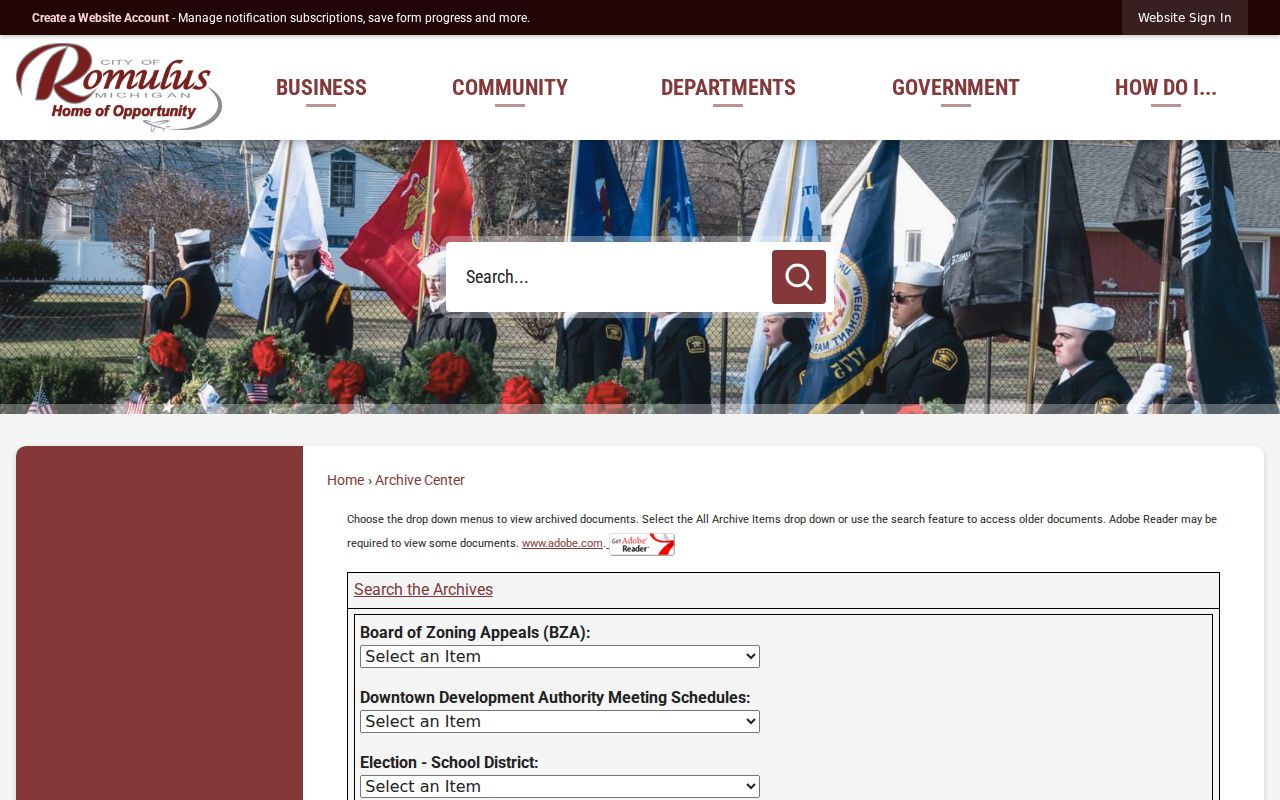
Archive results can add a dated planning, election, or public-notice clue to a property timeline, but they do not replace a recorded deed or establish occupancy.
Note: Romulus ordinarily responds to a FOIA request within five business days and may take a ten-business-day extension under the documented process.
Romulus Past Households in Dated Sources
Recorded owners are only one part of a past-household question. The Library of Michigan explains that city and county directories can connect a surname to a street, house number, occupation, other household names, owner notation, and sometimes a phone. No official online research in this run confirmed a Romulus-specific directory title or year run. Search by city, county, Downriver, Detroit-suburban, and township terms, then ask the Library of Michigan, Romulus Library, Museum, or Wayne repositories about the exact volume. The collections themselves are treated in the Romulus city directory material.
- Search the surname and street in two adjacent directory years when a volume is located.
- Log the edition, page or image, initials, spelling variant, and address exactly as printed.
- Pair the dated address clue with the relevant federal census schedule through the Library’s genealogy routes.
- Check the deed chain and assessment information to distinguish an address association from recorded title.
- Use a newspaper, yearbook, obituary, cemetery, or probate lead as a second source and retain the access date.
The Romulus Library newspaper collection makes Romulus and Huron papers from 1968 through 2008 searchable online, and it documents high-school yearbooks beginning in 1945 with access and missing-year limits. OCR can misread a surname or street. Check the page image, not just a search hit.
Romulus Address History at the Archives
The Romulus Historical Museum and Archives offers a more local layer for past residents. The City describes old maps, genealogies, assessment rolls, photographs, documents, Civil War diaries, Underground Railroad evidence, and early African-American family material. The Museum occupies the original 1839 schoolhouse, and the nearby Kingsley House dates to 1855. These holdings can explain an address or family connection that is absent from a deed index.
The same search can extend to cemetery context. Romulus Cemetery began as Blair Cemetery, and the research identifies a FamilySearch catalog item for a DAR microfilm of local gravestone inscriptions, subject to restrictions. A cemetery, newspaper, or obituary result closes a historical timeline only when another dated source supports it. It should not be used to infer a living relative’s present location.
The Historical Park and Archives page is the official source for the Museum’s local-history holdings.
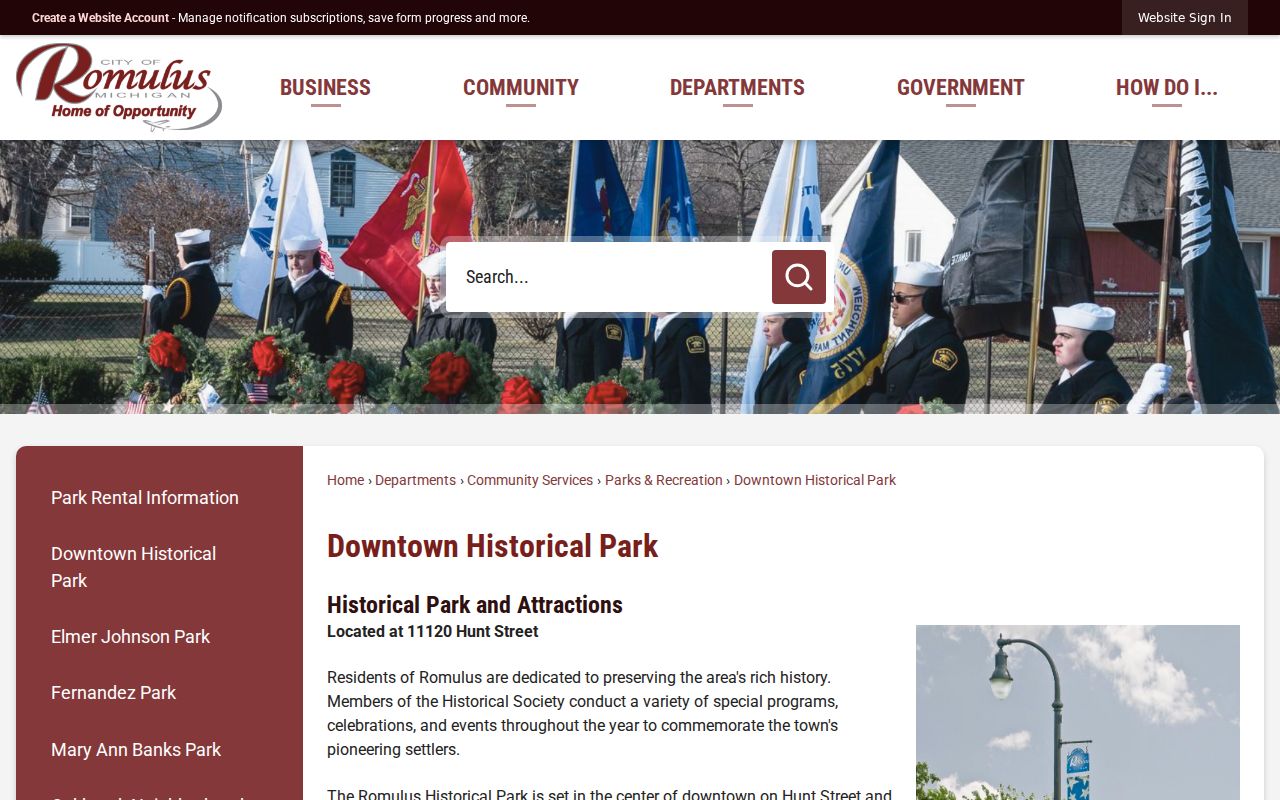
Museum maps and assessment rolls are especially useful beside a legal description, because they can add location context without turning an address search into a roster of living people.
No official Romulus-specific Sanborn map or dedicated online house-history guide was located. Do not treat Detroit Sanborn sheets as Romulus coverage. Ask the Library, Museum, Archives of Michigan, or Wayne repositories about county atlases, plats, fire-insurance maps, and manuscripts.
Romulus Address Labels Across Time
Romulus records can use township, city, airport, subdivision, county, and postal labels from different periods. The city was organized as a township in 1835 and incorporated as a city in 1970, while rail and airport development changed the local landscape. Those facts explain why a historical address search may need a legal description, nearby road, subdivision, or county reference in addition to its current mailing form.
No official source located a Romulus-wide street-renumbering or a dated renaming table. That is a reason to retain the printed address and the formal land description side by side, not a reason to manufacture an older number. For a defined address-change question, Planning and Assessment are the appropriate City contacts, with Wayne GIS providing the parcel map context.
Privacy for Romulus Previous Residents
Historical association is not current occupancy. Do not publish a living person’s full date of birth, phone, current address, or unneeded family details from an address trail. Michigan voter data has redacted fields, and the Michigan Address Confidentiality Program uses substitute-address protections for qualifying participants. City records requests should seek existing non-exempt records, not a list of people or protected data.
Lawful house-history use. Romulus previous-resident research is appropriate for family history, estate questions, property history, and civic context. Michigan’s anti-stalking law, MCL 750.411h, bars repeated unconsented contact that meets the statute’s conditions; never use a record trail to track, pressure, or harass a living person.
A reliable historical result is a dated chain: source, record type, page or image, URL, access date, and an uncertainty note. That format shows what the record supports and keeps a past-residents search from making unsupported claims about the present.